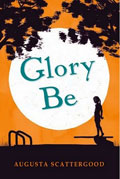
 Gloriana June Hemphill is looking forward to her annual birthday party at the community pool until she finds out that the pool will be closed for repairs. Glory is upset but she is also confused. Why would the pool close for repairs during the hottest time of the year? The summer of 1964 was a time of great change in America. It was a time when public pools, public libraries, and public water fountains were not available for everyone to enjoy or even use together. Readers can see that summer through the eyes of an innocent young girl. Glory realizes as she listens to her older sister, a new friend from Ohio, a remarkable librarian, and other people in her community that change is coming to her little Southern town. Glory Be is at the barest level the tale of two sisters, Jesslyn and Glory. But as Glory adjusts to an older sister who doesn't want to play childish games anymore like Junk Poker, she finds new friends and looks at old friends and her town with a clearer eye. While books "don't care who reads them" (Glory Be, p. 190), this story is one that many readers will care to read. It is an introduction to the Civil Rights movement that depicts one girl's fictional experience. This Newbery contender is one book that grandparents, parents, and children will want to read and discuss together.
Monday, July 30, 2012
Glory Be by Augusta Scattergood
Genre: Historical fiction, setting: Hanging Moss, Mississippi during the summer of 1964
 Gloriana June Hemphill is looking forward to her annual birthday party at the community pool until she finds out that the pool will be closed for repairs. Glory is upset but she is also confused. Why would the pool close for repairs during the hottest time of the year? The summer of 1964 was a time of great change in America. It was a time when public pools, public libraries, and public water fountains were not available for everyone to enjoy or even use together. Readers can see that summer through the eyes of an innocent young girl. Glory realizes as she listens to her older sister, a new friend from Ohio, a remarkable librarian, and other people in her community that change is coming to her little Southern town. Glory Be is at the barest level the tale of two sisters, Jesslyn and Glory. But as Glory adjusts to an older sister who doesn't want to play childish games anymore like Junk Poker, she finds new friends and looks at old friends and her town with a clearer eye. While books "don't care who reads them" (Glory Be, p. 190), this story is one that many readers will care to read. It is an introduction to the Civil Rights movement that depicts one girl's fictional experience. This Newbery contender is one book that grandparents, parents, and children will want to read and discuss together.

Saturday, July 28, 2012
Crow

Genre: Historical Fiction
Time and Place: 1898; Wilmington, NC
Historical Event: The Wilmington Massacre, aka The Wilmington Insurrection, aka The Wilmington coup d'etat
Point of View: 1st person, 11 year old Moses Thomas
"RIDE AN EAGLE AND SOAR"
Aside from the beautiful cover art which captures the mood and tenor of this powerful story, Barbara Wright has given readers a terrifying glimpse into the racially motivated riots known as the Wilmington Massacre. It is the era of Reconstruction. Moses Thomas' father is a city alderman in Wilmington, NC, and a reporter for the only Negro Daily in the South The Wilmington Daily. Moses' mother works for a rich white family, and his grandmother Boo Nanny, a former slave, still clings to the old ways. Moses is a typical boy who experiences both subtle and overt instances of racism, but under the guidance of his father he is learning how to stand firm against prejudice even when he is powerless to overcome it. At the time of the Insurrection, Wilmington had a strong black middle class, a black majority population, and a bi-racial Republican Party. The elections of 1898 (for city and county seats) were usurped by white supremacists who made an assault on the city and its black citizens, driving out the elected officials and businessmen. The result was the election of a democratically controlled city government which eventually influenced the state legislature to establish the first Jim Crow laws in North Carolina. Wright has written a story that balances history and fiction; horror and humor; language and ignorance; friendship and hatred; democracy and vigilantism. This is a story that soars.
Thursday, July 19, 2012
The Lions of Little Rock
"'I thought it might be hard always being quiet,' Liz said finally. 'I thought you needed a friend.'
She was right. I did.
'I needed a friend too,' said Liz.
And I suddenly knew what Liz was - a cup of warm milk with a dash of cinnamon." (The Lions of Little Rock pp. 40-41)
A good friend is hard to find. This is especially true for twelve-year-old Marlee Nisbett, a shy, intelligent girl growing up in 1958 Little Rock. Marlee is so shy that she hardly talks to anyone. Only a few trusted people like her mother, father, sister Judy, and brother David ever hear her speak.
 When Marlee attends her first day of junior high, she meets a new girl named Liz. Liz is smart, funny, and patient and turns out to be the perfect friend for Marlee. They spend time together visiting the zoo and playing magic square. With Liz’s encouragement, Marlee even agrees to talk during their class presentation. Then one day, out of the blue, Liz stops going to school. Marlee is stunned. Could the rumors be true? Was Liz a colored girl trying to pass for white? And if so, what does that mean for their friendship?
Kristin Levine artfully explores this lost year in Little Rock history, a year after the infamous Little Rock Nine took a stand against segregation. During the year of 1958, the high schools of Little Rock were closed in order to keep out black students. Many teenagers, like Marlee’s sister Judy, were forced to leave town and move in with relatives in order to continue their education.
Levine uses Marlee’s timid yet steadily growing voice to describe this painful period of Little Rock history. She ties in a wealth of factual information such as the role played by the Women’s Emergency Committee to Open Our Schools (WEC) and Stop This Outrageous Purge (STOP) in reopening the schools – this time, integrated.
Like the lions in the Little Rock Zoo, Marlee will not be silenced. She will fight for the rights of her friend despite all odds. But can one quiet girl from Arkansas really make a difference? Or is she placing all of their lives in danger?
Goodreads: 524 ratings; average of 4.13 stars
Goodreads: 524 ratings; average of 4.13 stars
Monday, July 16, 2012
The Mighty Miss Malone
"Once upon a time . . in Gary, Indiana, lived a family of three very special, very happy and uniquely talented people. I am the fourth member of that family and much too modest to include myself in such a grandiose description of their exalted number." p.4

We are the only family in the world, in my ken, that has a motto of our own! That motto is "We are a family on a journey to a place called Wonderful." p.12
Deza Malone is beloved by teachers and neighbors, spending afternoons at the library with her best friend her goal is to read every book in the public library. (How can a librarian not love this character?) Times are tough in Gary, Indiana, particularly for an unemployed African-American man. You wouldn't know it by Deza Malone, even though her teeth are rotting out and she's being given "used" clothes and shoes. No, you wouldn't know times were tough for Deza Malone until her playful father leaves town in hopes of finding a job. He's heard things are better elsewhere.
Roscoe Malone's departure sends each of the Malones on a journey of their own - to growing up, providing for a family, relying on oneself, and simply surviving.
With humor and heartache Curtis explores the life of young black girl in poverty stricken America. As his author's note acknowledges and I see everyday, there are far too many children for whom Deza's story would be familiar.
The Mighty Miss Malone made a brief appearance in Bud Not Buddy, Christopher Paul Curtis's 1999 Newbery and Coretta Scott King winner. I'm sure this year's committees will be taking look at Miss Malone.
Amazon: 11 ratings, with an average of 4.4 stars
Goodreads: 898 ratings, with an average of 4.01 stars
Starred reviews by Kirkus and Publishers Weekly.
A few of the more complete reviews can be found at The Horn Book, Fuse #8 and The Book Smugglers.
This is also an excellent audiobook. Curtis's reading of his dedication was the perfect amuse bouche for the compelling reading by Bahni Turpin.
Thursday, July 12, 2012
The One and Only Ivan
"Gorillas are as patient as stones. Humans, not so much. " (The One and Only Ivan p. 3)
 Anthony Browne made me fall hard for gorillas. His Gorilla is in my top 5 picture books of all time. He is genius. But that doesn't mean I automatically love all things gorilla. In fact, I tend to cast a wary eye on fictionalized talking, art-making gorillas. I have read The One and Only Ivan by Katherine Applegate twice, and have just begun my third reading. The story gets better each time. It is an animal fantasy written from the point of the view of Ivan a silverback gorilla who in real life did live nearly thirty years in a glass enclosure in a mall in Washington state. Ivan's voice is quiet and his prose simple and uncluttered. Ivan can speak with the other animals in the Big Top mall, but he can not communicate with humans except through his art. Ivan can't read, but he can draw and his keeper Mack capitalizes on Ivan's talent by selling his finger paintings in the mall gift shop. Ivan remembers his family and life in the jungle before he was captured, but it isn't until a baby elephant joins the brood at the mall and is mistreated that he makes a promise that will change their lives forever. Children will love this book It is not heavy-handed in its treatment of animal cruelty and neglect, but neither does it back off from describing the stark reality of animals living in captivity. Applegate is sensitive to her readers and allows for a gradual awakening to the horror of Ivan's life and the power of memory to restore one to a better home.
The One and Only Ivan has a rating of 4.35 stars on Goodreads with 1,712 ratings and 523 reviews.
How does this book compare to Charlotte's Web-the finest example of animal fantasy we have and a winner of a Newbery Honor in 1952? Monica Edinger had this to say on her blog Educating Alice.

The One and Only Ivan has a rating of 4.35 stars on Goodreads with 1,712 ratings and 523 reviews.
How does this book compare to Charlotte's Web-the finest example of animal fantasy we have and a winner of a Newbery Honor in 1952? Monica Edinger had this to say on her blog Educating Alice.
Monday, July 9, 2012
May B. A Novel

Our group is still working out the nuts and bolts of our mock award blog and will have more details later, but today I will kick off our reading list discussion with an introduction to May B. A Novel by Caroline Starr Rose. Please join us in our discussion with comments. Voting will be available at a later date.
I've already posted a review of May B. to my personal site, and had planned to write a new introductory post here. However, after posting my initial review, I was pleasantly surprised (to say the least), when the author linked to my site from May B.'s Facebook page, noting that my review, "speaks so truly to what" she "tried to create." With that in mind, I will repeat most of my original post here.
Rose, Caroline Starr. 2012. May B. New York: Random House.
In Kansas' early days as a state, there is no help in the prairie schools for a child with what will later become known as dyslexia. Nor is there help for a farmer whose spring wheat crop has failed.
So it is neither unforeseen, nor unusual when the parents of Mavis Elizabeth Betterly, May B., literally "farm her out" as hired help to a prairie neighbor. Hiram, the Betterly's son, will stay at home, he, being of more use to the frontier family.
The closest homestead is 15 miles away, a full day's journey by wagon. Young May Betterly passes the long hours to the Oblinger's simple, sod house that will be her home until Christmas,
I play a game inside my head,
counting plum trees that dot a creek bed,
rabbits that scatter at the sound of wagon wheels,
clouds that skirt the sky.
For hours, that is all,
and grass,
always grass,
in different shades and textures
like the braids in a rag rug.
Miss Sanders told us that lines never end,
and numbers go on forever.
Here,
in short-grass country,
I understand infinity.
When Mrs, Oblinger takes a horse and deserts her new husband to return east, Mr. Oblinger goes off in pursuit.
"Don't worry about supper," he says. "I could be gone some time.""Some time" will be longer than May could ever have dreamed. It will take all of her courage, strength and perseverance to survive.
I am afraid
in the dark
all alone
I am afraid
###
In similar style to Karen Hesse's Newbery-winning, Out of the Dust, and Witness, Caroline Starr Rose's novel in verse is deeply affecting. May's honesty in assessing her shortcomings is balanced by her inner optimism that she may yet overcome her situation - against all odds.
We all share that struggle. May B. gives voice and hope to us all.
###
Please, share your thoughts. Thanks.
Friday, July 6, 2012
Honor Books with Staying Power
In a previous post, Shelf-Employed talked about a book’s staying power and asked why it is that certain Newbery winners have greater staying power than others. I’d like to take this a step further and look at honor books that have, for one reason or another, become more popular over the years than their winning counterparts.
I’ve found several examples dating back to the 1930s. Here are just a few:
1988 Winner: Lincoln: A Photobiography by Russell Freedman
1988 Honor Book: Hatchet by Gary Paulsen
1982 Winner: A Visit to William Blake’s Inn: Poems for Innocent and Experienced Travelers by Nancy Willard
1982 Honor Book: Ramona Quimby, Age 8 by Beverly Cleary
1953 Winner: Secret of the Andes by Ann Nolan Clark
1953 Honor Book: Charlotte’s Web by E. B. White
1942 Winner: The Matchlock Gun by Walter Edmonds
1942 Honor Book: Little House on the Prairie by Laura Ingalls Wilder
1939 Winner: Thimble Summer by Elizabeth Enright
1939 Honor Book: Mr. Popper’s Penguins by Richard and Florence Atwater
Perhaps you recognize some of these Newbery winners, but if you ask a group of children, they will probably be much more familiar with the honor books.
So why do we still know and love these honor books even though the winners have fallen into obscurity? Perhaps it has something to do with an author’s work after winning an award. Some may continue writing but never receive the same level of recognition with their later works. Others, such as Laura Ingalls Wilder, may go on to publish a multitude of much-loved stories that push them to an even higher level of regard. If Little House on the Prairie was not part of the Little House series, would we still remember it today?

Technology may also play a role in a book’s staying power. Your library surely saw an increase in requests for Mr. Popper’s Penguins after the 2011 movie was released. Would Thimble Summer see a surge in popularity if it too was made into a movie? Or are books made into movies because they are popular? Along the same lines, I wonder if nonfiction titles and books of poetry are at a disadvantage if they cannot be translated to the big screen.
Technology may also play a role in a book’s staying power. Your library surely saw an increase in requests for Mr. Popper’s Penguins after the 2011 movie was released. Would Thimble Summer see a surge in popularity if it too was made into a movie? Or are books made into movies because they are popular? Along the same lines, I wonder if nonfiction titles and books of poetry are at a disadvantage if they cannot be translated to the big screen.

Could it be that the Newbery committees were flat wrong with their selections? Probably not. In 1942, The Matchlock Gun, a story about ten-year-old Edward Van Alstyne defending his family with a gun during the French and Indian War, likely rang true to an audience struggling with their own fear of Nazi invasion. Today, when the threat of war does not weigh as heavily on the minds of our youth, children may have a hard time relating to Edward’s peril. Or perhaps this book has lost popularity due to its negative portrayal of Native Americans. I think we can all agree that a book’s success goes hand in hand with the social and cultural climate of its time. When this climate changes, some books may no longer connect with readers.

Why do you think certain honor books have greater staying power than winners? Should the Newbery committee be concerned with a book’s staying power when making their selections?
Tuesday, July 3, 2012
Help! My maid melted my sugar basin.

Subscribe to:
Posts (Atom)